
From a Meriden Arrest to GA 7 Court Records
A Meriden case follows a clear path. Police make the arrest. They book the person. The file then goes to a prosecutor. The prosecutor reviews it and files the formal charges, and that filing opens a court case. The case file, not the booking sheet, is the court record people want. Meriden has no county court. Local criminal and motor vehicle matters are heard in the state Superior Court at Geographical Area No. 7.
GA 7 sits at 54 West Main Street in Meriden. The Chief Clerk's Office can be reached at 203-238-6130. Court hours run 9:00 a.m. to 5:00 p.m., and the doors open at 8:30 a.m. The court serves five towns: Cheshire, Hamden, Meriden, North Haven, and Wallingford. Where a case is heard depends on how serious the charge is. GA 7 is a Part B court. It handles class C, D, and E felonies, misdemeanors, infractions, and motor vehicle offenses. The most serious charges, the class A and B felonies, move to the New Haven Judicial District Part A court instead.
The arrest side and the court side are two records, not one. Booking and custody detail sit on the jail inmate records path, and any booking photo is covered on the jail mugshots page. The court record is the charge filing tracked through the case. A person can be out of custody and still have an open court case. The two records can also list different offenses, since the prosecutor may not file the exact charge the arrest report shows.
How to Search Meriden Court Records After an Arrest
The Connecticut Judicial Branch runs free public case lookups, and they cover Meriden cases. The criminal and motor vehicle hub links to several tools: pending cases, daily dockets, convictions, and docket-number search. To find the charges filed after a Meriden arrest, the pending criminal and motor vehicle search by defendant is the place to start. Arrest and booking detail does not show there. That lives with Meriden Police and with the state corrections system.
The hub page lays out each lookup option in one place, so it helps to know which one fits the question before searching. The page also carries the official notice that a case lookup is a public service, not the court's official record.
The Judicial Branch publishes the lookup hub at its criminal and motor vehicle case lookup page.
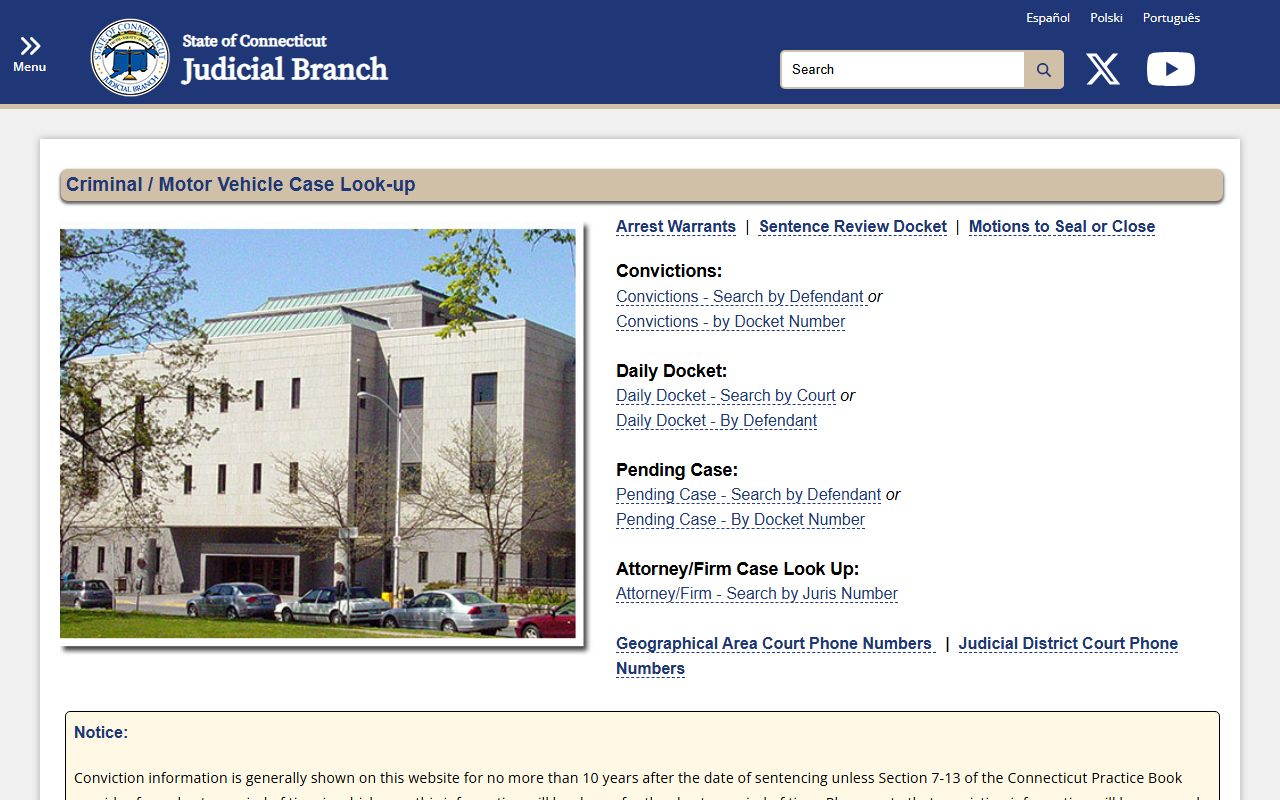
From that hub, a reader picks the pending-case search and runs the steps below for a Meriden GA 7 case.
- Open the Judicial Branch pending criminal and motor vehicle search by defendant.
- Type the last name in the "Last Name begins with" field. Add a first initial or birth year to narrow common names.
- Set Court Location to Meriden Geographical Area 7 and pick a CategoryType of Criminal or Motor Vehicle if needed.
- Open the matching case and read the charge list.
- Check each charge for its code, level, and current status.
If paperwork already lists a docket number, the docket-number search is faster. For Meriden GA 7, the GA/JD code is N07M. The Type field takes CR, MV, CI, or MI, with CR and MV covering common criminal and motor vehicle matters. The remaining fields are the docket Year, the Number, and a Suffix. For a statewide criminal-history check rather than a single case, the search runs through the State Police, covered further below.
Meriden Court Case Search Fields
The Meriden pending-case defendant search uses a short set of fields. Only the last name is required. The rest narrow the results, which matters in a city the size of Meriden where common surnames return long lists. The table below lays out each control on the form and what it does for a Meriden search.
| Field | Required | What It Does |
|---|---|---|
| Last Name begins with | Yes | Defendant last name or its first letters. |
| First Initial | No | Narrows common last names. |
| Birth Year | No | Helps tell apart similar names. |
| Year Range | No | Limits the search to a date span. |
| Court Location | No | Select Meriden Geographical Area 7 (N07M). |
| CategoryType | No | Criminal, Motor Vehicle, or referred suspension. |
The Meriden docket-number search asks for different inputs. It needs the GA/JD code, shown as N07M for Meriden GA 7, plus the Type, the Year, the Number, and a Suffix. Those five parts together point to one exact case. The defendant form below shows the same name-based layout in the live portal.
The Judicial Branch hosts the pending criminal and motor vehicle defendant search for these lookups.
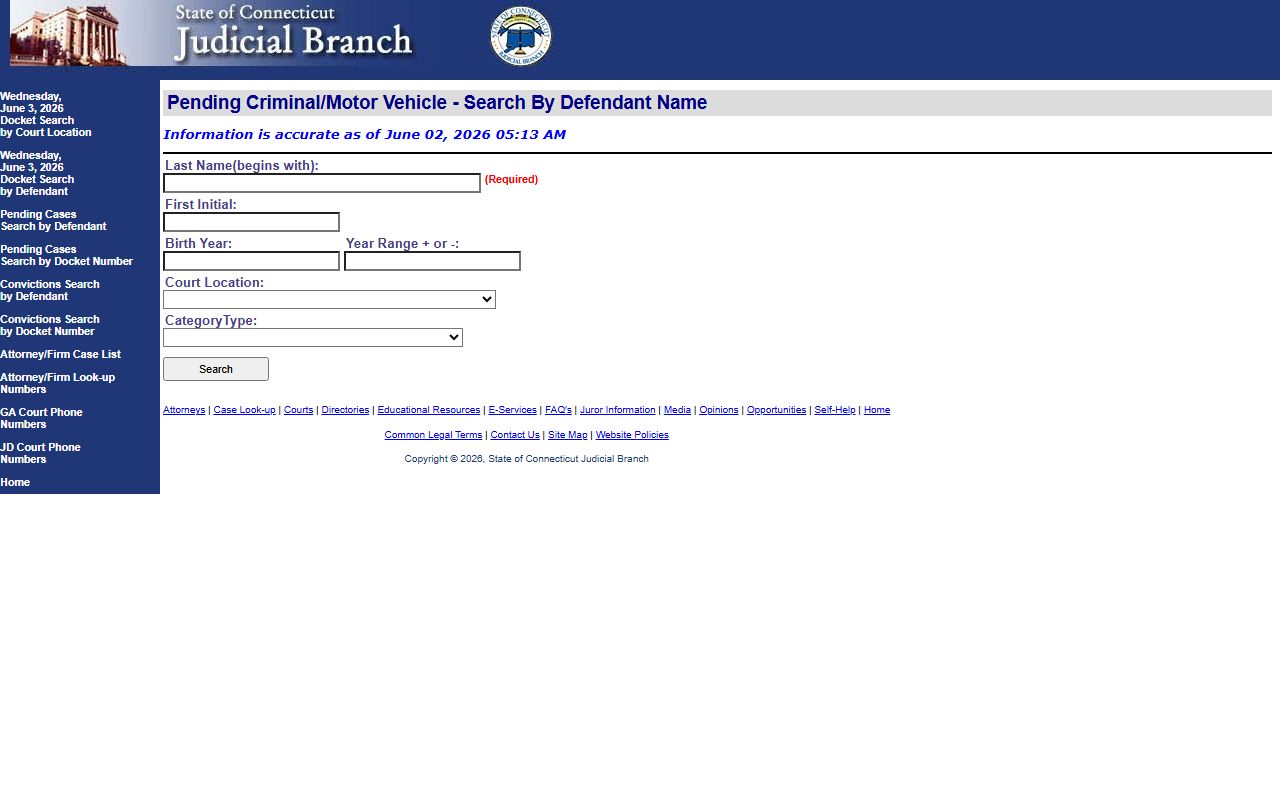
The Court Location dropdown on that form is where a reader picks Meriden GA 7 to keep results local.
Meriden Daily Docket, Pending Case, and Conviction Records
The Judicial Branch splits its Meriden lookups by purpose, and each one covers a different slice of the record. Picking the wrong tool returns nothing, so it pays to match the search to the question. There are three broad views: the daily docket, the pending-case search, and the conviction search.
The daily docket shows what is scheduled in court today. A search by court location lists the day's matters at Meriden GA 7. A search by defendant finds a person's appearance for the current day. The present day's docket and future dockets are disclosable, but previous days' dockets are not. The pending-case search covers open cases that have not yet ended. The conviction search shows results after sentencing, and that display is generally limited to the last 10 years. Youthful offender cases, juvenile cases, infractions, and violation convictions do not appear.
One point matters across all three Meriden lookups. None of them is the official court record. The Judicial Branch states plainly that the online display is a public service, not the official file, and should not stand in for a real criminal background check. Online data can change daily as erasures, corrections, and pardons are processed. Verify anything important against the record on file at the court.
The Prosecutor Behind Meriden Court Records
In Connecticut, prosecutors are State's Attorneys, not county district attorneys, and Meriden has no county prosecutor. Meriden falls in the New Haven Judicial District. The State's Attorney for that district is John P. Doyle Jr. He oversees the offices that prosecute Meriden cases. At the GA 7 court in Meriden, the office is led by Supervisory Assistant State's Attorney John Lion. The Meriden State's Attorney's Office for G.A. No. 7 sits at 54 West Main Street and can be reached at 203-238-6125.
The prosecutor's choice is why arrest charges and court charges can differ in a Meriden case. Police list offenses at the time of arrest. The prosecutor then reviews the file and decides what to actually file. Charges can be added, reduced, dropped, or replaced. So a reader may see one offense in a police report and a different charge set in the court case. The court record reflects the prosecutor's decision, which is why it is the record that counts.
Crime victims have a separate contact. For cases prosecuted at Meriden GA 7, the Victim Advocate is Tracy Baden at 203-238-6446. Victims can also sign up for case and custody updates through CT SAVIN and VINELink. The Division of Criminal Justice keeps an official page for the GA 7 office and its Part B jurisdiction at its New Haven office and court locations page.
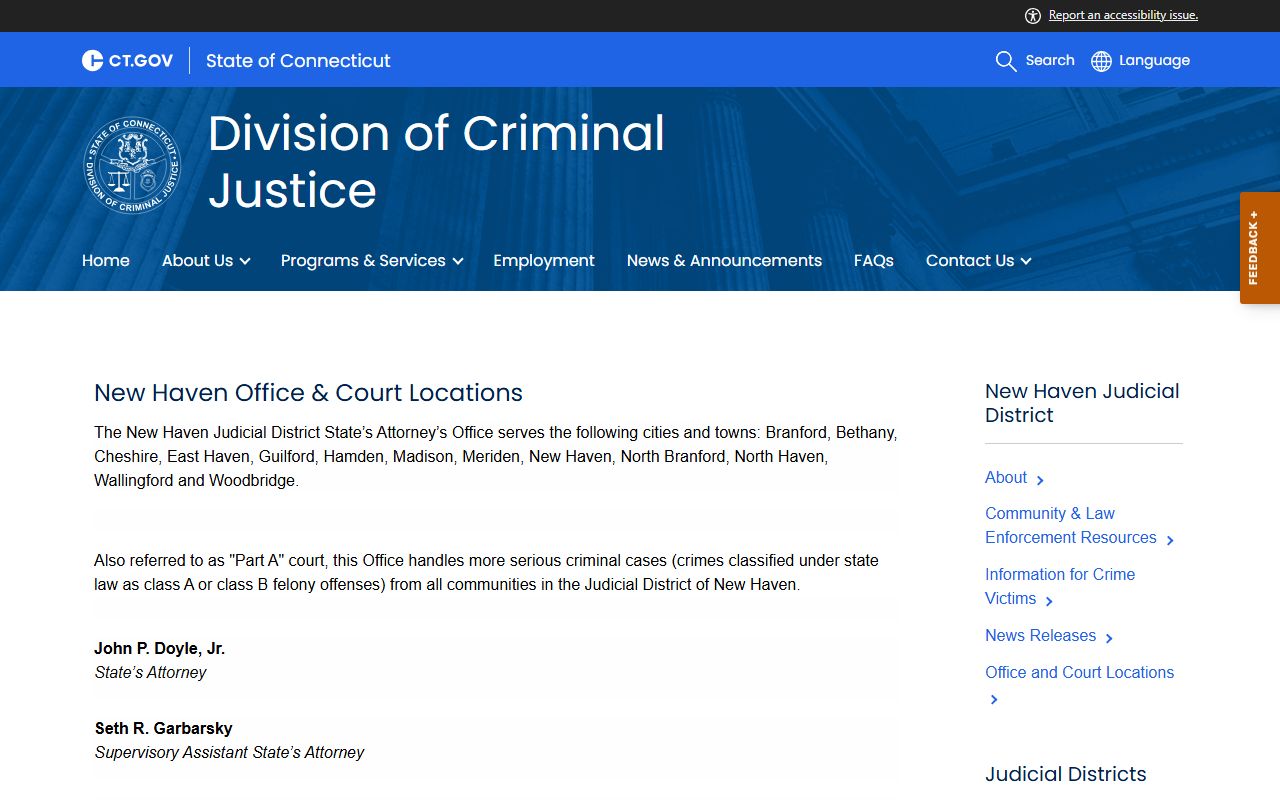
That page confirms the GA 7 office handles Part B matters for Cheshire, Hamden, Meriden, North Haven, and Wallingford.
Charge Status in Meriden Court Records
Charges are not fixed once a Meriden case opens. They move as the case moves. A count can be amended, reduced, added, or dropped. Some are dismissed. Others end with a nolle. Because the prosecutor controls the filing, the booking charges on the arrest side can differ from the charges that finally appear in court. Reading the status next to each charge is how a searcher tells where a case really stands.
| Status | What It Means |
|---|---|
| Pending | The charge is open and the case has not yet ended. |
| Amended / Reduced | The prosecutor changed the charge or lowered its level. |
| Dismissed | The charge was thrown out and is no longer prosecuted. |
| Nolle Prosequi | The prosecutor chose not to proceed, subject to state procedure. |
A nolle is not the same as a dismissal, and neither is a conviction. A dropped or nolled charge can later qualify for erasure under state law. That clears it from the public record. The point to hold onto is simple. A charge in a case file is an accusation, and its status shows whether the state is still pressing it.
How Charges Get Filed in a Meriden Case
The Meriden court record begins when the state files a charging document. Booking happens first, at the police level. The case itself starts only when a formal charge is filed. Three document types do that work, and which one is used depends on how serious the offense is and who brings it.
| Complaint | Information | Indictment | |
|---|---|---|---|
| Filed By | Officer / Prosecutor | Prosecutor | Grand Jury |
| Common For | Misdemeanors | Many felonies | Serious felonies |
| Starts | The case | The case | The case |
In Connecticut practice, the State's Attorney drives most charging through an information. The arresting officer's complaint often opens lower-level matters. Whatever the document, the result is the same. A case number is assigned. The charges are recorded. The court record opens for public search. That is the file the GA 7 lookup pulls up.
Bail and Release After a Meriden Arrest
Bail is the condition meant to make sure a person comes back to court. After a Meriden arrest, bail can be set by Meriden Police, by Pretrial Services staff, or by a judge. If someone cannot post a bond the police set, the police must notify bail staff. Pretrial Services then interviews the person and may raise or lower the amount. If release conditions still cannot be met, the person is presented at the Meriden court, where a judge addresses release.
Connecticut allows several release paths, from a simple written promise to a posted bond. Bail can be posted in full cash, through a licensed bondsperson, or with a 10 percent cash option. Since January 1, 2020, that 10 percent option is automatically available for bail set at $20,000 or less unless a judge orders otherwise. Money can be posted at the police department, at the courthouse, or at the corrections facility where the person is held. The table below sorts the common release types.
| Release Type | How It Works |
|---|---|
| Written promise to appear | No money posted; a signed promise to return to court. |
| Nonfinancial conditions | Release with supervision or restrictions, no bond payment. |
| Bond without surety | A bond obligation set without a licensed surety. |
| Bond with surety | Bond posted through a licensed bondsperson. |
| Full cash bail | The full amount paid in cash at police, court, or DOC. |
| 10 percent cash option | Ten percent paid; automatic for bail at or under $20,000 since Jan. 1, 2020. |
Cash or 10 percent bail is returned when a diversionary program is granted, when the person is acquitted, when charges are dismissed, or at sentencing. A hold can still keep someone in custody even after bail is posted, such as a separate warrant or a detainer from another agency. For bail questions at the Meriden court, GA 7 Bail Services answers at 203-238-6140. Note: a posted bond does not always mean release, because a separate hold or detainer can keep a person in custody.
Warrants, Failure to Appear, and Violation of Probation
An outstanding warrant is a common road into a booking. A person picked up on a Meriden warrant is processed by police and then either released on bond or held and presented at the Meriden court. The Judicial Branch runs one public warrant search, for arrest warrants tied to violation of probation, failure to appear, and orders to incarcerate. It is not a full list of every warrant. Meriden Police do not publish a public warrant roster.
The warrant search uses a small set of fields. A name search needs at least the first two letters of the last name. The other fields narrow the results, including a Town dropdown that lists Meriden among the choices and a Court Location dropdown that includes Meriden GA 7.
| Field | Required | Notes |
|---|---|---|
| Last Name | Yes | At least the first two letters. |
| First Name begins with | No | Optional narrowing field. |
| Birth Year | No | Optional. |
| Town | No | Includes Meriden and South Meriden. |
| Court Location | No | Includes Meriden GA 7. |
The official warning matters. The portal does not contain all warrant types, and the public should not act on what it shows. A warrant may be left off if posting it would risk safety or if it came from a youthful offender case. Arrest warrants are generally open to the public after the arrest unless a court has sealed them. The Judicial Branch hosts the warrant search for violation of probation and failure to appear.
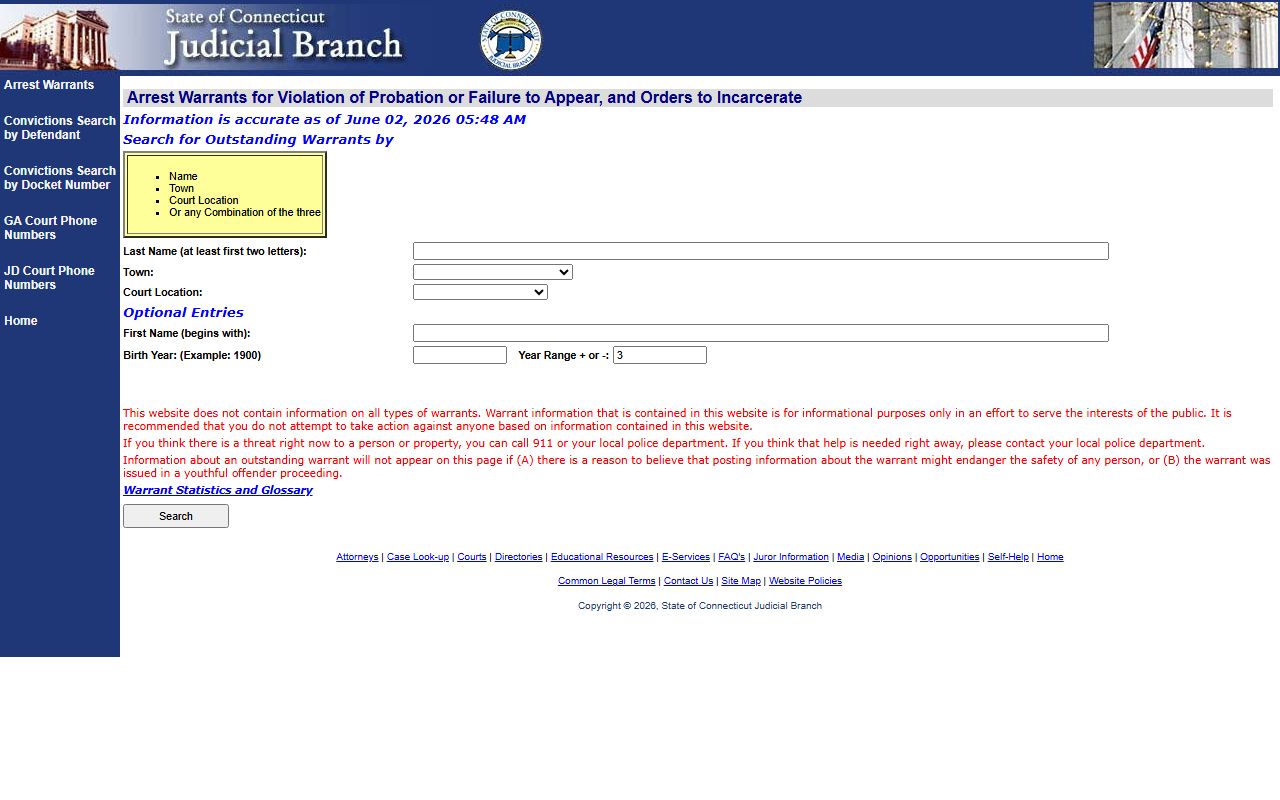
The town and court filters on that page let a searcher hold the results to Meriden and the GA 7 court.
Charges vs. Convictions in Court Records
Being arrested and charged in Meriden is not the same as being convicted. A charge is an accusation. A conviction is the outcome, reached by a plea or a verdict. The state must clear a much higher bar to convict than to charge. Both can appear in public records, but they mean very different things, and the table makes the gap clear.
| Charge | Conviction | |
|---|---|---|
| Stage | Accusation | Verdict or plea |
| Burden of Proof | Probable cause | Beyond reasonable doubt |
| Public Record | Yes | Yes |
Custody tells the same caution. A person can be held at a corrections facility before trial while still presumed innocent. The conviction lookup shows results generally for 10 years after sentencing, while a pending charge shows only that the case is open. Treat a charge as what it is. It is the start of a case, not its end.
Erasure and Clean Slate in Connecticut
Connecticut does not use the words "sealed" and "expunged" the way many states do. It uses erasure, and the same rules reach Meriden records. Under CGS Sec. 54-142a, criminal records are erased when a person is found not guilty or when the charges are dismissed. The erasure statutes sit in Chapter 961a of the General Statutes. Once a record is erased, the police, court, and prosecutor records for that charge are treated as erased, and the person can lawfully state the matter never happened.
Connecticut's Clean Slate law goes further. It erases certain qualifying convictions automatically after a set waiting period, without the person filing anything. Eligibility depends on the offense and how much time has passed. The law also reaches data resellers. Under CGS Sec. 54-142e, anyone who purchases bulk criminal records of public record must update their files and permanently delete records that have been erased.
This is why a charge seen one month may be gone the next. Erasure changes what the public can find. The state keeps current, official pages on the rules. The Clean Slate program explains who qualifies on its eligibility page and how to reach criminal records on its record-access page. Note: erased records are not public records, so they will not show up through routine court or warrant lookups.
Court Record Limits and Copy Fees
Not every part of a Meriden court file is open, and copies are not free. Criminal files are generally open unless a judge has sealed them. Convictions are open. Arrest warrants are generally open after the arrest unless sealed, and search warrants are generally open after they are executed and returned. Some records stay closed. Bail interview records are closed under CGS Sec. 54-63d(e). The present day's docket is disclosable, but previous days' dockets are not.
To get a record from the Meriden court, a written record-search request goes to the GA court where the arrest happened. The request should give the person's name, date of birth, and, if known, the arrest or disposition date. The search is limited to that one court location, so a Meriden matter is searched at Meriden GA 7. Copy fees are set by the court. Court records and documents cost $1.00 per page, and administrative records cost $0.25 per page.
Statewide Criminal-History Background Checks
A single Meriden court case is not a background check. For a full statewide criminal history, the request goes to the Connecticut State Police Bureau of Identification within DESPP. That office handles official criminal-history record checks and processes them by mail only, with set fees and fingerprinting steps. The Division of Criminal Justice, which prosecutes Meriden cases, does not provide criminal records to the public and points people to State Police, the Judicial Branch, and the corrections system instead.
So the channels split by job. Use the Judicial Branch for a single Meriden case. It shows the docket and convictions. Use the State Police Bureau of Identification for a statewide record check. The State Police keep their request rules on the Bureau of Identification page.
Important: Meriden Inmate Population is not a consumer reporting agency under the FCRA, and nothing here may be used for employment, credit, insurance, or tenant screening.
Getting to GA 7 for Meriden Court Records
For Meriden court records that must be handled in person, the courthouse is on the corner of West Main Street and Grove Street at 54 West Main Street. The clerk's office runs 9:00 a.m. to 5:00 p.m., with doors open at 8:30 a.m. Parking is a municipal lot on the immediate left right after the courthouse, marked by a large yellow parking sign. Wheelchair access is through the front door, and ADA accommodations are requested through the local court contact. Local bus service runs through CTtransit.
The directions page rounds out the practical detail and lists the court's phone lines, including the Chief Clerk's Office at 203-238-6130 and Bail Services at 203-238-6140. The Judicial Branch publishes the GA 7 directions, hours, and parking on its Meriden court directions page.
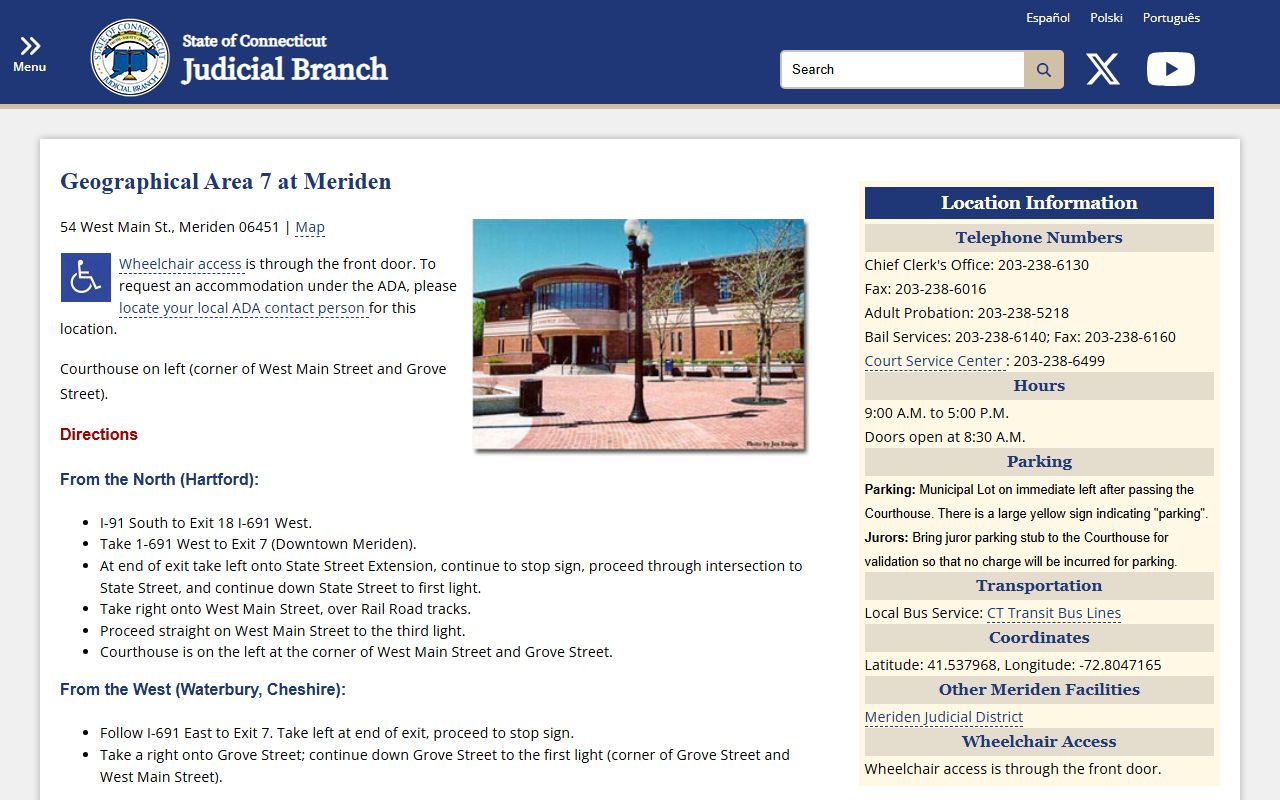
That page also notes the courthouse is two doors from the police records office, since both sit on West Main Street.